
The new framework enables hardware companies to go from zero infrastructure to a fully automated testing pipeline in days, leveraging an AI agent to generate register-level tests from PCB designs.
Today, BootLoop announced the launch of BootLoop Test. The end-to-end hardware-in-the-loop (HIL) testing framework is built to make automated, hardware-validated testing accessible to every engineering team, drastically lowering the historical barrier to entry for robust firmware verification. The framework is designed to allow any hardware company to transition from zero testing infrastructure to a fully automated pipeline in a matter of days.
While HIL testing is widely considered one of the most important practices a hardware company can adopt. That said, the majority of engineering teams operate without any rigorous testing infrastructure. Historically. The problem is that building a hardened HIL framework requires dedicated test engineers, months of custom development, and specialized skills that most firmware teams do not possess.
With all that in mind, many companies either forgo testing entirely or rely on ad hoc scripts and manual validation processes that slow development cycles, miss critical firmware errors, and lead to fragile release pipelines.

Founded by Noah Pacik-Nelson (left) and Chris Markus (right), BootLoop’s launch was backed by funding from Y Combinator.
To learn more about BootLoop Test, I spoke with the company’s two co-founders: Noah Pacik-Nelson (CEO) and Chris Markus (CTO).
BootLoop Test: From Zero to CI in Hours
BootLoop Test addresses these lifecycle and deployment bottlenecks by providing a complete HIL platform that spans the entire embedded product lifecycle. Rather than spending months on custom internal tools and framework development, engineering teams can use a single-command installation to establish a full continuous integration (CI) pipeline running on real hardware in just hours.
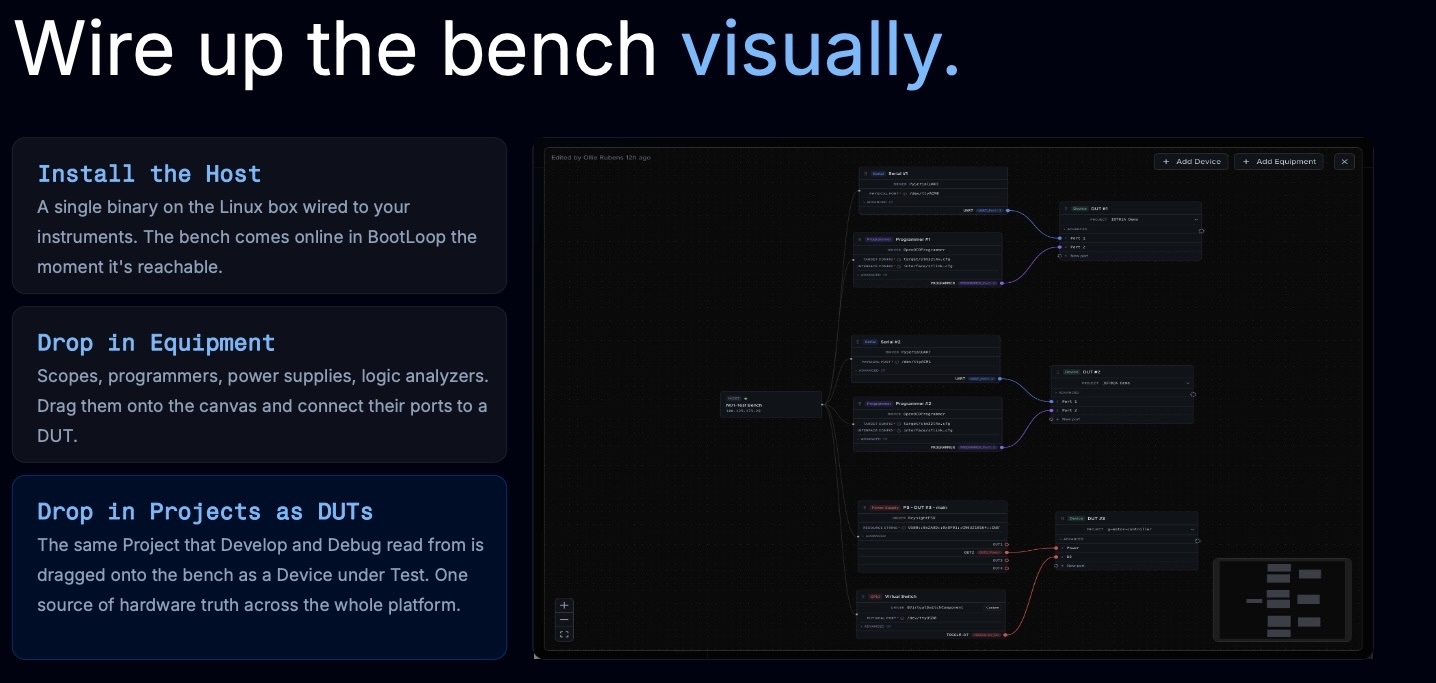
With BootLoop Test you can wire up your test bench visually. (Click on image to enlarge).
The comprehensive framework unifies bench testing, automated CI pipelines, and end-of-line validation onto a single platform. This structural continuity ensures that development teams can leverage a single cohesive platform from initial prototyping through final mass-production lines.
“BootLoop Test is basically two things,” says Noah Pacik-Nelson. “It’s a state-of-the-art hardware-in-the-loop test framework for automated testing.”
“It’s designed to make it very, very easy for companies to go from no automated test coverage to fully automated test coverage. But it also enables you to have AI help you throughout the whole process.”
AI-Generated, Hardware-Accurate Validation
A core architectural feature of the new platform is its AI-native testing agent. Instead of requiring engineers to manually author complex, tedious suites of test code, the BootLoop agent directly ingests printed circuit board (PCB) design files and component datasheets.
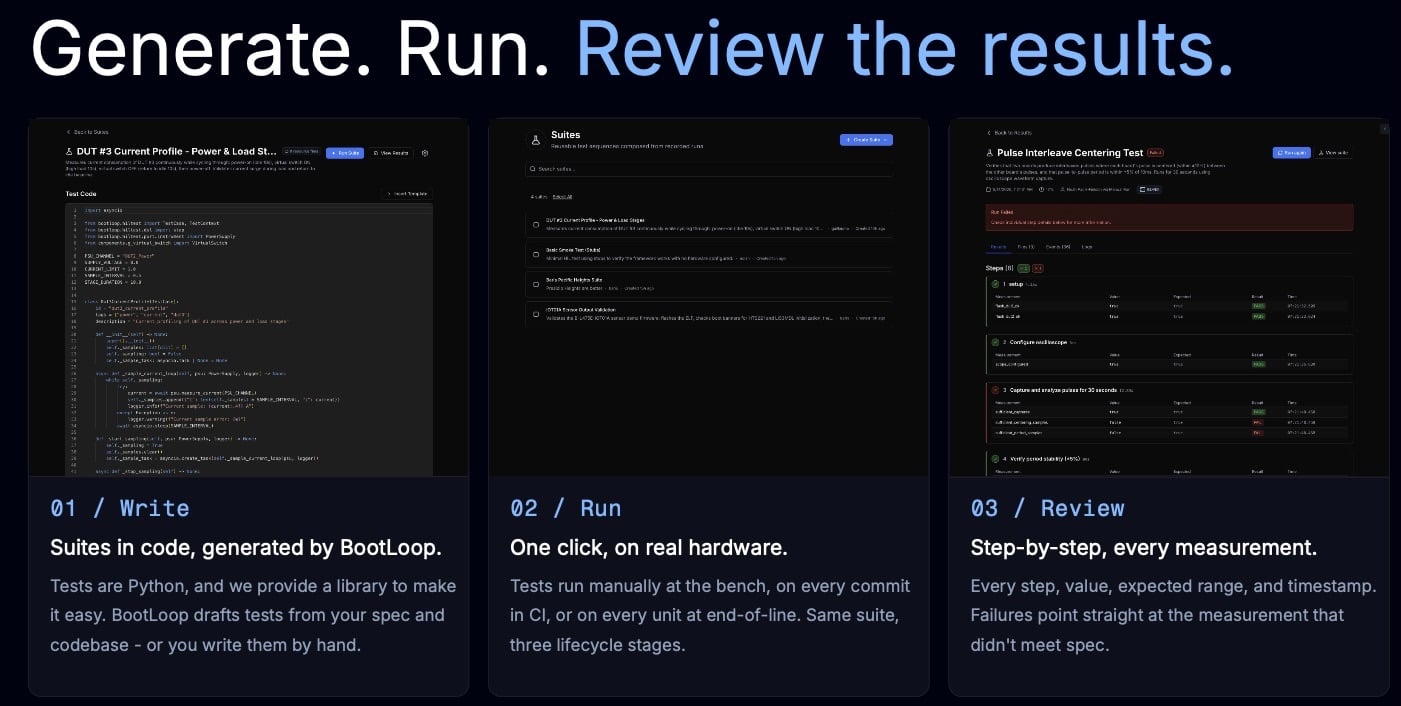
BootLoop Test generates your test suite, runs it on real hardware, and lets you review the results. (Click on image to enlarge).
Using this design documentation, the platform automatically generates hardware-accurate tests capable of validating real hardware behavior down to the register level. This tight integration ensures that peripheral configurations and hardware-level interfaces operate exactly as intended without requiring manual script generation.
In the velocity of the whole test development goes to the heart of what BootLoop Test provides. “What BootLoop Test allows you to do in part is to generate your tests once, and then iterate on them as a whole company as you bring your hardware through the different stages,” says Chris Markus. “That saves a huge amount of time because not only is testing just a confidence thing and a reliability thing, but it’s also a velocity thing.”
Targeting Regulated Markets via ITAR Compliance
Backed by Y Combinator and founded by veteran engineers from SpaceX and the MIT Media Lab, BootLoop aims to provide smaller and mid-sized hardware teams with the development speed, engineering resources, and operational rigor previously available only to large enterprises and the world’s leading engineering organizations.
Crucially for engineering teams working in defense, aerospace, and other highly controlled sectors, the platform features ITAR compliance. This marks it as the first AI-native development platform accessible to regulated hardware markets. Beyond automated testing, BootLoop’s broader product suite covers the complete embedded lifecycle, integrating development, testing, and debugging.
For his part, Markus was previously a firmware and software engineer at SpaceX. “These BootLoop tools are the tools I wanted when I was working at SpaceX,” says Markus. “When I was doing those really deep in the weeds firmware development and then later the higher-level software for hardware development, BootLoop tools could have been used to drastically speed up what we were doing in a lot of ways.”
Commercial Availability
BootLoop Test is available now. Hardware teams interested in evaluating the framework, reviewing technical capabilities, or scheduling a product demonstration can find more information by visiting the BootLoop’s website.
The platform arrives as hardware development teams face mounting pressure to deliver robust firmware without letting manual validation processes cause release bottlenecks. By automating the HIL infrastructure pipeline and generating register-level tests directly from PCB documentation , BootLoop is positioning its platform to deliver enterprise-grade hardware verification to the broader engineering community without the custom overhead traditionally required.
All images used courtesy of BootLoop.
Trending Products
