
At Computex 2026, the company is expanding its Edge AI ecosystem by introducing the Snapdragon C Platform for entry-level laptops, and the Dragonwing IQ10 Reference Design for robotics.
Ahead of Computex 2026 this week, Qualcomm has introduced two major additions to its product stacks: the Snapdragon C platform for budget-conscious computing devices and the Dragonwing IQ10 Robotics Reference Design (RRD) for advanced industrial automation.
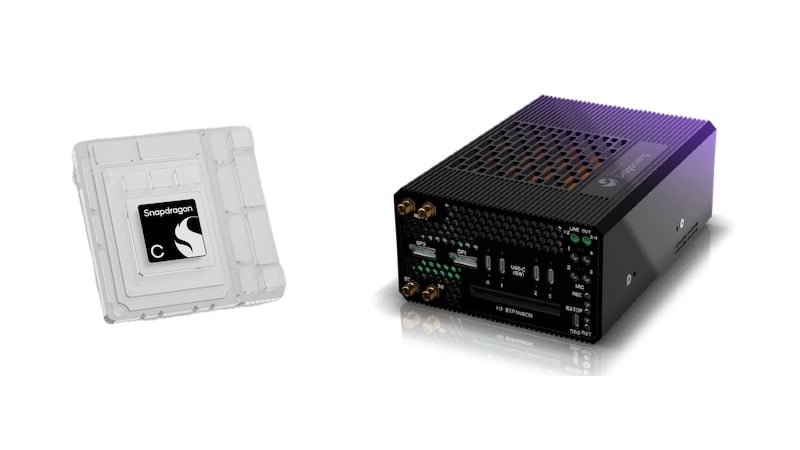
Qualcomm’s Snapdragon C (left) and Dragonwing IQ10 Robotics Reference Design (right).
To learn more about these new products, All About Circuits attended a media briefing. The Qualcomm Technologies speakers included Mandar Deshpande, Senior Director, Product Management and Suranjeeta Choudhury, Director, Product Marketing.
Snapdragon C: Democratizing NPU Acceleration at the Entry Tier
Historically, advanced on-device Neural Processing Units (NPUs) have been restricted to mainstream and premium computing platforms due to thermal constraints and silicon costs. With the debut of the Snapdragon C platform, Qualcomm targets entry-tier laptops with a projected baseline retail cost of approximately $300.
The platform architecture focuses on extending core Snapdragon efficiency parameters to budget-sensitive consumer demographics, frontline enterprise workers, and education sectors. Even though this is an entry-level framework, the device integrates a dedicated hardware NPU.
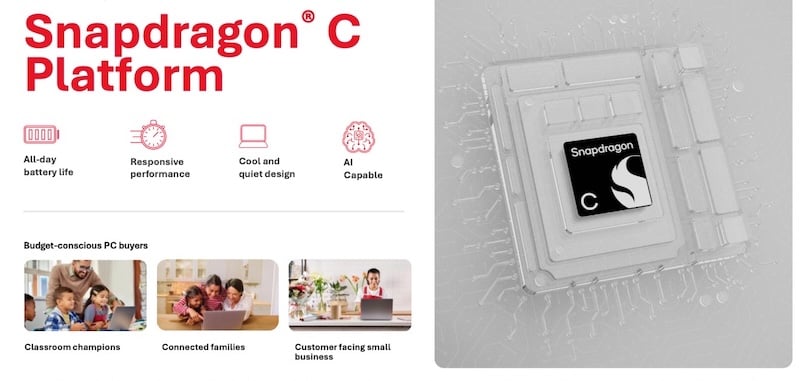
The Snapdragon C brings NPU-enhanced processing to budget-constrained PC users.
This silicon area handles low-latency, always-on agentic tasks, allowing budget laptops to run localized generative workflows, automated productivity scripting, and real-time audio/video enhancement without relying constantly on cloud processing.
“With the Snapdragon C, we’re bringing the Snapdragon core advantages to a price point that reaches students, families, small business owners, frontline workers—everyone,” says Deshpande. “It means you get all the benefits like all-day battery life, a responsive system, lag-free performance, browsing, video calls, streaming, multitasking—everything.”
From a thermal engineering standpoint, Qualcomm says the Snapdragon C architecture enables highly efficient, cool, fanless configurations. By removing the active cooling assemblies (fans and large heat pipe systems) standard in typical budget architectures, systems designers can shrink device profiles while eliminating acoustic noise and lowering long-term physical failure rates.
“With the Snapdragon C, you’re going to get cool and quiet laptops without a loud fan noise, no heat—it’s a laptop that just works,” says Deshpande.
“The great thing is even in this lowest tier of the platforms, we have a built-in NPU, which means you can enjoy AI experiences on Snapdragon C built platforms.”
Ecosystem integration is already underway, with major OEMs including Acer, HP, and Lenovo actively building hardware variants around the platform for commercial availability in the coming weeks.
At the time of this article’s publication, Qualcomm does not appear to have a product page for the Snapdragon C.
Dragonwing IQ10 RRD: Overcoming the Robotics Integration Bottleneck
While computing scaling steps downward into budget layers, advanced robotics applications demand unprecedented steps upward in raw sensor processing and tight multi-axis synchronization. Systems designers building Autonomous Mobile Robots (AMRs) and humanoid devices face severe integration hurdles, often spending significant engineering overhead linking disparate systems for high-performance compute, vision perception pipelines, precise deterministic motor actuation, and safe fault isolation.
To eliminate this fragmentation, Qualcomm has introduced the Dragonwing IQ10 Robotics Reference Design (RRD). Rather than providing standalone System-on-Chips (SoCs), the IQ10 RRD is delivered as a production-ready, fully enclosed, plug-and-play hardware module. It aggregates high-performance compute arrays, safe industrial deterministic input/output (I/O) configurations, multi-sensor ingress structures, and optimized AI execution frameworks directly within a single physical layout.
“What we have seen as we have made this journey is that these robotics systems today are inherently complex,” said Choudhury. “We’re bringing together high-performance compute, multi-sensor perception, and real-time control. That’s combined with deterministic I/O, AI models, and the entire life cycle of the software that goes behind these devices.”
The computing side of the IQ10 RRD is particularly strong, according to Choudhury. “It comes with 700 TOPS of on-device AI, extensible up to 2,000 TOPS with additional compute add-on capability,” she says.
“The system is powered by 18 Qualcomm Oryon CPUs, multi-core NPUs, and an advanced GPU.”
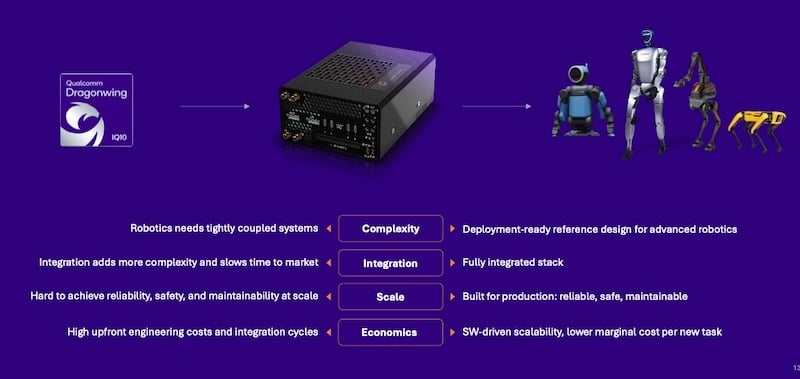
The Dragonwing IQ10 Robotics Reference Design takes you from an SoC to a validated robotics reference design.
Qualcomm Dragonwing IQ10 RRD Technical Specifications:
- Compute Subsystem 18× Custom Qualcomm Oryon CPU cores, multi-core NPU array, and advanced GPU architecture
- AI Performance 700 TOPS baseline on-device AI performance (Scalable up to 2,000 TOPS via compute expansion modules)
- Memory & Media 16 GB + 16 GB high-bandwidth LPDDR5 with Error-Correcting Code (ECC); Hardware-accelerated 8K video pipelines
- Sensor Ingress Up to 12× high-speed GMSL2 camera interfaces supporting concurrent multimodal vision perception
- Deterministic I/O 2x 10G Base-T interfaces, 1x isolated 10G Base-T Safety link, 4x CAN FD channels, and hardware-level EtherCAT support
- Wireless Capabilities Integrated Wi-Fi and Bluetooth; high-speed 5G modem expansion capability via an internal PCIe slot
- Software Framework Ubuntu Linux Foundation environment complete with on-device LLM engines and end-to-end MLOps lifecycle tools
At its core, the IQ10 RRD is built around the flagship Dragonwing IQ10 SoC architecture. The processing matrix pairs 18 custom Qualcomm Oryon CPU cores with an expansive multi-core NPU configuration to deliver a baseline computing metric of 700 TOPS.
For intensive physical AI applications requiring local dense model execution, this capability can scale to 2,000 TOPS by attaching dedicated hardware compute accelerator modules over a high-bandwidth internal bus. At the time of this article publication, Qualcomm does not appear to have a product page for this reference design. However, More information can be found in the IQ10 Robotics Reference Design Product Brief.
GMSL2 and Deterministic I/O In Advanced Autonomous Systems
In advanced autonomous systems like humanoids and heavy AMRs, real-time sensor processing and absolute predictability in motor control are critical safety prerequisites. To manage complex visual environments, the IQ10 RRD incorporates Gigabit Multimedia Serial Link Gen 2 (GMSL2) interfaces. GMSL2 is a high-speed, point-to-point serial link protocol designed to stream uncompressed, high resolution video data from up to 12 asynchronous camera nodes over long cable distances (up to 15 meters) with minimal latency and high electromagnetic immunity—a vital requirement for expansive robotic chassis.
Simultaneously, the reference design manages motion actuation through specialized deterministic I/ O sub-systems. Unlike standard networking protocols where data packets face variable routing delays (jitter), deterministic networks like EtherCAT and Controller Area Network Flexible Data-Rate (CAN FD) ensure that command frames arrive at precise, microsecond-aligned intervals.
The IQ10 RRD enforces this by routing safety-critical networking links through an independent, hardware-isolated Safety Island inside the silicon. This sub-system acts as a fault-isolation ring, verifying that even if the primary operating system experiences an exception, real-time braking vectors, position telemetry, and obstacle avoidance routines execute uninterrupted.
Software Life Cycle and Commercial Deployment
Recognizing that deployment speed depends on developer accessibility, Qualcomm has matched the physical IQ10 RRD hardware block with a unified software architecture running an enterprise-grade Ubuntu Linux framework. The stack natively integrates localized Large Language Model (LLM) processing runtimes, allowing future industrial robots to interpret complex semantic commands directly on the factory floor without introducing round-trip cloud latency or security risk.
Additionally, the system embeds comprehensive Machine Learning Operations (MLOps) lifecycle mechanisms. Engineers can manage edge infrastructure from initial asset configuration and on device model training validation through to massive fleet management updates and real-time remote diagnostic telemetry.
The platform has already garnered support from a diverse ecosystem of robotics and embedded engineering partners, including Neura Robotics, Advantech, APLUX, Booster, Innodisk, MeiG, NEXCOM, Radxa, Thundercomm and VinMotion. The company says early access deployment units are scheduled to seed to enterprise customers starting in June 2026, establishing a physical foundation ahead of broader industrial rollout.
Qualcomm intends to follow up this launch sequence with a deep financial and architectural dive spanning physical AI, data centers, and its new 6G connectivity nodes at its highly anticipated Investor Day event later this year in New York.
All images used courtesy of Qualcomm.
Trending Products
